NATURA Members
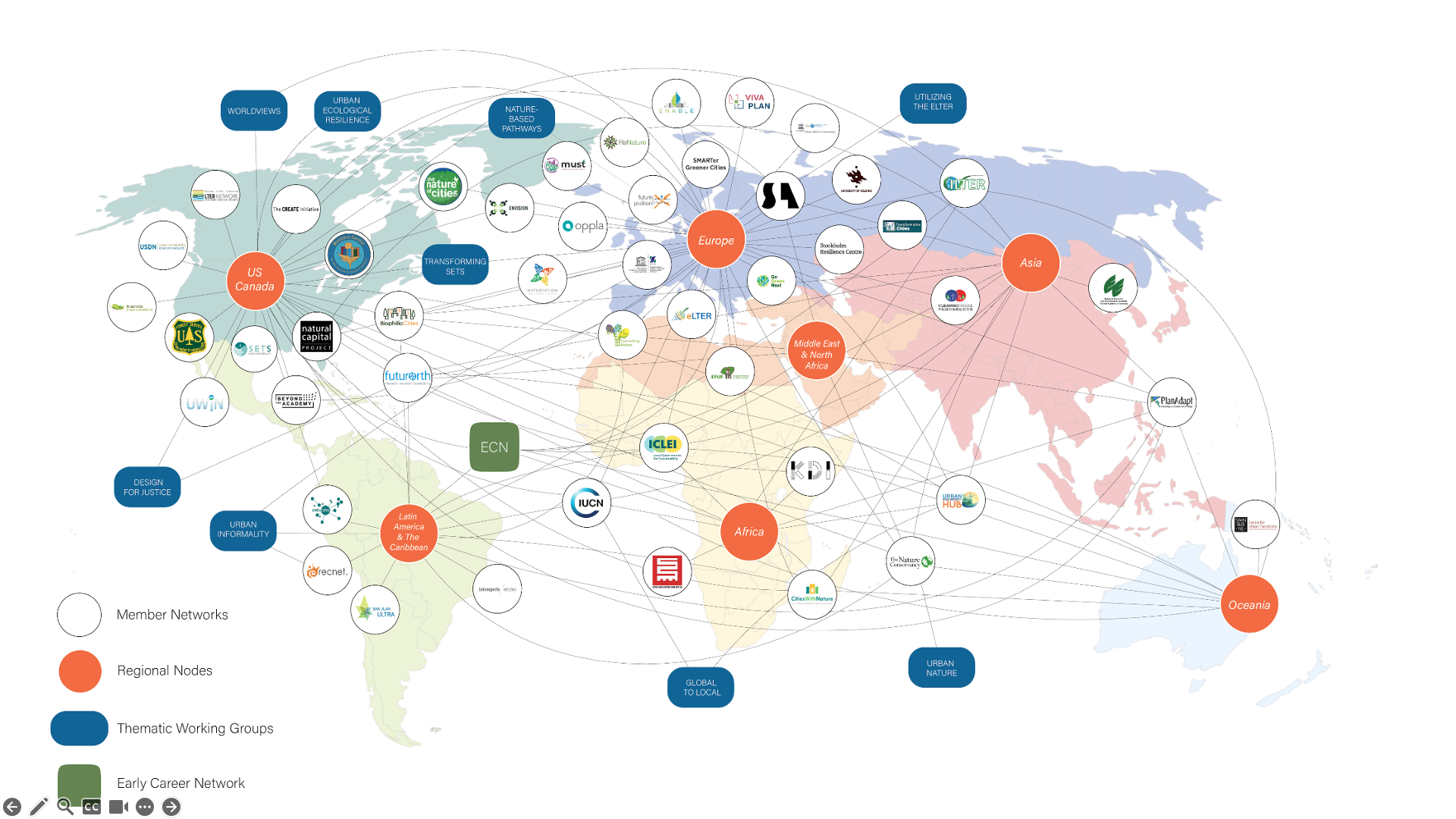
NATURA includes 50+ partner networks, 400+ active members, and 1,100+ researchers and practitioners across Africa, Asia, Oceania, Latin America, North America, the Middle East, and Europe. NATURA is a network of networks, brought together by a shared commitment to evidence-based, equitable nature-based solutions for cities.
Future Earth is a global network of scientists, researchers, and innovators collaborating for a more sustainable planet.
Our mission is to advance research in support of transformations to global sustainability.
Our vision is of a sustainable and equitable world for all, where societal decisions are informed by openly-accessible and shared knowledge.
ENVISION is a 3-year project funded through the 2017-2018 Belmont Forum and BiodiveERsA joint call under the BiodivScen ERA-Net COFUND programme. The ENVISION project will result in the development of several communications and policy tools to identify, compare and balance the multiple visions for any given area. ENVISION will also enhance understanding about social and ecological consequences of protected area management with an aim to facilitate reflection on future growth and landscape change.
ENABLE aims to advance knowledge of how to design and implement GBI in a way that maximises its potential to deliver numerous social and environmental benefits, such as social inclusion, health and human wellbeing, stormwater retention and habitat functions. This ambition will be pursued by developing and testing multi-method assessment frameworks, analytical tools and approaches for evaluating GBI performance. ENABLE is a recipient of the Biodiversa Prize for Excellence and Impact.
SLA is a nature-based design studio working globally with cities, nature, places, and people.
Point of Contact: Alexandra Burgos-Thorsen
The MUST project co-creates knowledge to interrelate the needs of humans and other species. The interdisciplinary team brings together researchers from environmental education to human geography, environmental economics, spatial ecology, resilience in urban and regional planning and geospatial approaches, exploring how to change our relationship with nature.
Point of Contact: Chris Raymond
The wide-ranging and multidisciplinary Ecosystems and Environment Research Programme (ECOENV) investigates the effects of human activity on land and aquatic ecosystems, as well as how these effects are reflected in society. Our researchers are looking for solutions to current environmental problems. Societally, research-based knowledge in environmental sciences can be used to curb climate change as well as foster biodiversity and habitats in support of environmental and human wellbeing.
Point of Contact: Erik Andersson
The Stockholm Resilience Centre, is a research centre on resilience and sustainability science at Stockholm University. It is a joint initiative between Stockholm University and the Beijer Institute of Ecological Economics at the Royal Swedish Academy of Sciences.
Point of Contact: Erik Andersson
KDI is a non-profit design and community development organization founded in Nairobi in 2006 with offices in Kenya, Sweden, and the US. We partner with under-resourced communities to advance equity and activate the unrealized potential in neighborhoods and cities through advocacy, research, planning, and built works.
Point of Contact: Franklin Kimiri
The Partnership for Water Sustainability in British Columbia (the Partnership) is the hub for a “convening for action” network in the local government setting, is responsible for delivering the Water Sustainability Action Plan program through partnerships and collaboration, and embraces a vision for shared responsibility where all the players align their efforts for the greater common good.
The Converging Social, Ecological, and Technological Infrastructure Systems (SETS) for Urban Resilience project is a 5-year initiative to accelerate advances in convergent urban systems science capable of providing cities with the knowledge and methods for building integrated SETS resilience strategies to extreme events, supported by cutting-edge modeling, simulation, and visualization of infrastructure systems. The project will develop and refine an urban resilience conceptual framework to guide an emerging, convergent urban systems science for cities to test and deploy in San Juan (PR), Atlanta, New York, and Phoenix.
Point of Contact: Mikhail Chester
CLEARING HOUSE uses trees as a means to improve urban living in both Europe and China.
Point of Contact: Rik De Vreese
The Western Center for Metropolitan Extension and Research works to increase the internal capacity of Extension programs to address metropolitan issues. We partner with cities, NGO’s, and businesses – connecting our partners with university professionals working across the United States – to develop place-based and data-driven solutions to societal issues. In the past few years, we have focused on urban sustainability and green infrastructure, urban-suburban-rural interdependencies, and creating a culture of health across connected communities.
Point of Contact: Brad Gaolach
VIVA-PLAN is about revitalising in-between spaces in residential housing areas to promote nature conservation, social inclusion and human well-being.
Point of Contact: Christopher Raymond
The UWIN Network is a consortium of multiple academic institutions and key water industry partners with activities currently in six regions across the U.S. designed to address water challenges in a variety of contexts from coastal communities to high plain deserts.
Point of Contact: Mazdak Arabi
The Urban Biodiversity Hub (UBHub) helps cities around the world to measure and promote their biodiversity and assess their biodiversity strategy. We work with municipal and other local governments and their partners to improve the efficiency and effectiveness of their biodiversity planning, according to the goals they set for themselves.
Point of Contact: Jennifer Rae Pierce
The US Forest Service’s mission is to sustain the health, diversity, and productivity of the Nation’s forests and grasslands to meet the needs of present and future generations.
Point of Contact: Sarah Hines
The Urban Sustainability Directors Network (USDN) is a peer-to-peer network of local government professionals from communities across the United States and Canada dedicated to creating a healthier environment, economic prosperity, and increased social equity.
Point of Contact: Kristin Baja
The Urban Resilience to Extremes Sustainability Research Network (UREx SRN) focuses on integrating social, ecological, and technical systems to devise, analyze, and support urban infrastructure decisions in the face of climatic uncertainty.
Point of Contact: Nancy Grimm
UNESCO European Regional Centre for Ecohydrology (ERCE): Development of ecohydrological biotechnologies and systemic solutions by international cooperation in the framework of UNESCO International Hydrological Programme and European Commission projects.
Point of Contact: Maciej Zalewski
The UNESCO Chair on Sustainability (UNESCO-SOST) is an international centre of excellence for resilience and sustainability science applied for transformation at local and regional scales.
Point of Contact: Jordi Morató
Future Position X is a non-profit network organization that was founded in 2006 when regional actors gathered in an initiative for the Gävleborg region to take the position "Sweden's leading geospatial information cluster".
Points of Contact: Henrik Dahl & Per Andersson
The SMARTer Greener Cities project aims to develop and test novel tools and processes for explicitly converging social, ecological, and technological systems (SETS) approaches for improving life in cities.
Point of Contact: Erik Andersson
The San Juan Urban Long-Term Research Area (ULTRA) is a long-term network and research site established in the city of San Juan in 2009 by the USDA Forest Service and the National Science Foundation (NSF) to produce knowledge on urban areas and to support policy, education, and local initiatives in order to improve the quality-of-life and environmental conditions in the city.
Point of Contact: Elvia Meléndez
ReNature establishes a nature-based solutions research and innovation strategy and cluster, consisting of practitioners, national authorities, businesses, NGOs and researchers. Activities carried out foster capacity-building and collaboration to mainstream evidence-based implementation of nature-based solutions.
Point of Contact: Mario Balzan
The RECNET network comprises more than 60 organizations from 27 different countries, born with the purpose of finding the collaboration of key stakeholders in re-thinking the transformation of cities for sustainable transition to more resilient socio-ecological systems.
Point of Contact: Duván Hernan Lopez
PlanAdapt is an independent network-based organization, that provides knowledge services in support of effective, economically just and socially inclusive climate change adaptation and climate risk management around the world.
Point of Contact: Alannah Hofemeier
Oppla is a knowledge marketplace for the latest thinking on natural capital, ecosystem services and nature-based solutions. Oppla is supported by a global community of several thousand members, comprising businesses, policymakers, scientists and researchers, as well as representatives from government and civil society. Membership is free and includes access to a growing number of knowledge platforms and projects.
Point of Contact: Paul Mahoney
The Nature of Cities is an international platform for transdisciplinary dialogue and urban solutions.
Point of Contact: David Maddox
The Nature Conservancy is a global environmental nonprofit working to create a world where people and nature can thrive.
Point of Contact: Anna Bettis
NATure-based URban innoVATION is a 4-year project, funded by the European Commission and involving 14 institutions across Europe in the fields of urban development, geography, innovation studies and economics.
Point of Contact: Harriet Bulkeley