
Nature-based solutions for Urban Resilience in the Anthropocene.
An international network to advance transdisciplinary collaboration on urban nature-based solutions.
50+
International Partners52
Member Networks10
Working Groups7
World RegionsNews & Upcoming Events
-
![]()
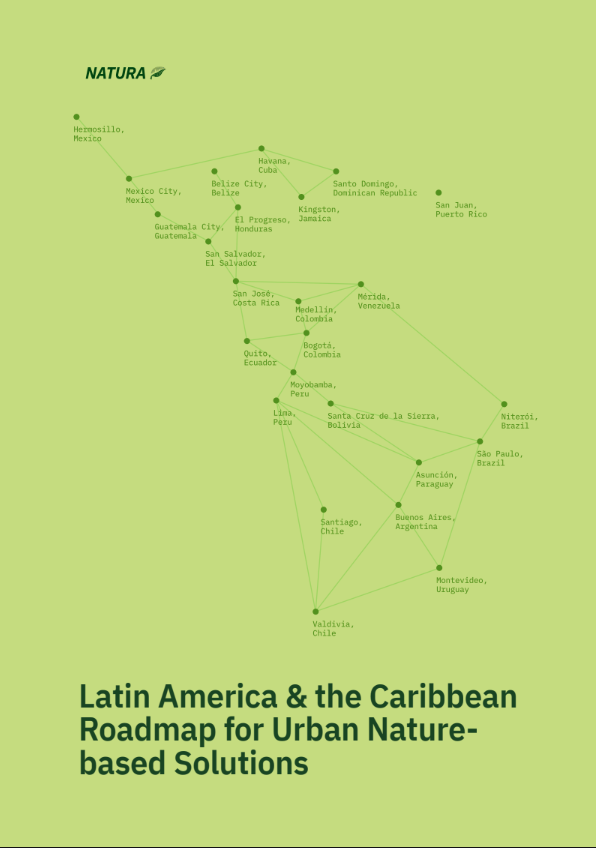
Latin America & The Caribbean Roadmap on Urban Nature-based Solutions Launch
Presentation now available to watch on-demand. This event took place September 28th, 2026.
-
![]()
NATURA Global Roadmap for Urban Nature-based Solutions
Explore the most comprehensive effort to date to assess the state of knowledge and practice of nature-based solutionS (NbS) in cities and urbanized regions around the world.
-
![]()
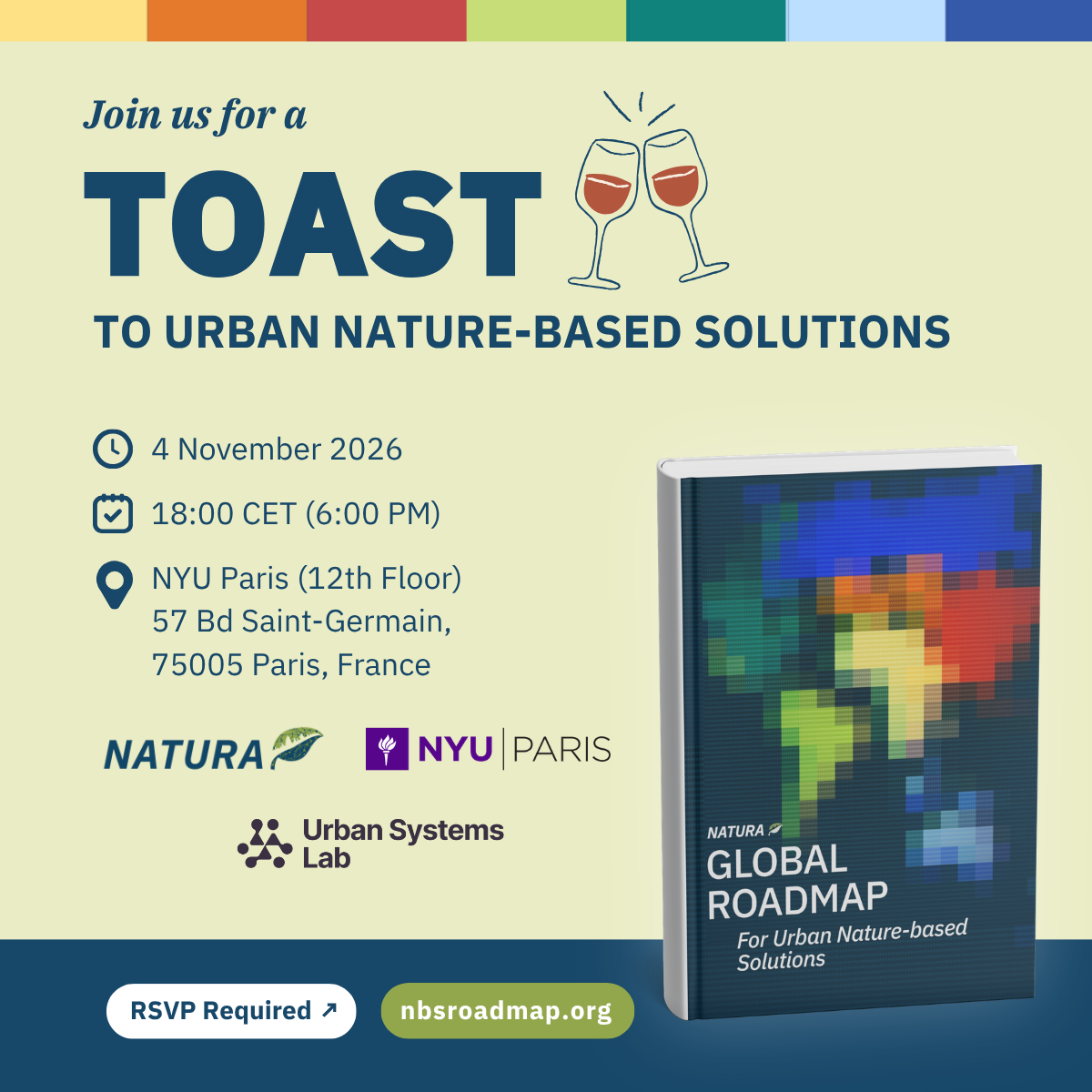
NBS World Congress and NATURA GRM Reception
November 4th | Location: NYU Paris
Join us in Paris for a reception celebrating the launch of the NATURA Global Roadmap. Connect with researchers, practitioners, and partners from the global NATURA community, discover key insights from the Roadmap, and learn how you can contribute to the future of the network.

About Us
The Nature-based solutions for Urban Resilience in the Anthropocene (NATURA) network brings together 50+ international partners to advance transdisciplinary collaboration on urban nature-based solutions.
Established in 2019 with support from the U.S. National Science Foundation (NSF), NATURA fosters knowledge exchange across research and practice to strengthen the design and implementation of NbS in diverse urban contexts. NATURA has been co-led by Nancy Grimm (Arizona State University), Timon McPhearson (New York University, formerly at The New School), and Elizabeth Cook (Barnard College/Cary Institute).
Network Members
NATURA is a community of researchers and practitioners collaborating across the seven world regions
50+ member networks
10 Thematic Working Groups
Hundreds of researchers and practitioners from 7 world regions
Future Earth is a global network of scientists, researchers, and innovators collaborating for a more sustainable planet.

ENVISION develops communications and policy tools to help stakeholders identify, compare, and balance multiple visions for protected area futures by deepening understanding of how management decisions shape social and ecological outcomes and landscape change.

ENABLE aims to advance knowledge of how to design and implement GBI in a way that maximises its potential to deliver numerous social and environmental benefits, such as social inclusion, health and human wellbeing, stormwater retention and habitat functions.

SLA is a nature-based design studio working globally with cities, nature, places, and people.

The MUST project co-creates knowledge to interrelate the needs of humans and other species.
ECOENV investigates the effects of human activity on land and aquatic ecosystems, as well as how these effects are reflected in society.
The Stockholm Resilience Centre, is a research centre on resilience and sustainability science at Stockholm University. It is a joint initiative between Stockholm University and the Beijer Institute of Ecological Economics at the Royal Swedish Academy of Sciences.
Point of Contact: Erik Andersson

KDI is a non-profit design and community development organization founded in Nairobi in 2006 with offices in Kenya, Sweden, and the US. We partner with under-resourced communities to advance equity and activate the unrealized potential in neighborhoods and cities through advocacy, research, planning, and built works.

The Partnership for Water Sustainability in British Columbia (the Partnership) is the hub for a “convening for action” network in the local government setting, is responsible for delivering the Water Sustainability Action Plan program through partnerships and collaboration, and embraces a vision for shared responsibility where all the players align their efforts for the greater common good.
A 5-year initiative to accelerate advances in convergent urban systems science capable of providing cities with the knowledge and methods for building integrated SETS resilience strategies to extreme events, supported by cutting-edge modeling, simulation, and visualization of infrastructure systems.
The Western Center for Metropolitan Extension and Research works to increase the internal capacity of Extension programs to address metropolitan issues.

VIVA-PLAN is about revitalising in-between spaces in residential housing areas to promote nature conservation, social inclusion and human well-being.

The UWIN Network is a consortium of multiple academic institutions and key water industry partners with activities currently in six regions across the U.S. designed to address water challenges in a variety of contexts from coastal communities to high plain deserts.
The Urban Biodiversity Hub (UBHub) helps cities around the world to measure and promote their biodiversity and assess their biodiversity strategy.

The US Forest Service’s mission is to sustain the health, diversity, and productivity of the Nation’s forests and grasslands to meet the needs of present and future generations.

The Urban Sustainability Directors Network (USDN) is a peer-to-peer network of local government professionals from communities across the United States and Canada dedicated to creating a healthier environment, economic prosperity, and increased social equity.
The Urban Resilience to Extremes Sustainability Research Network (UREx SRN) focuses on integrating social, ecological, and technical systems to devise, analyze, and support urban infrastructure decisions in the face of climatic uncertainty.

UNESCO European Regional Centre for Ecohydrology (ERCE): Development of ecohydrological biotechnologies and systemic solutions by international cooperation in the framework of UNESCO International Hydrological Programme and European Commission projects.
The UNESCO Chair on Sustainability (UNESCO-SOST) is an international centre of excellence for resilience and sustainability science applied for transformation at local and regional scales.
Future Position X is a non-profit network organization that was founded in 2006 when regional actors gathered in an initiative for the Gävleborg region to take the position "Sweden's leading geospatial information cluster".

The SMARTer Greener Cities project aims to develop and test novel tools and processes for explicitly converging social, ecological, and technological systems (SETS) approaches for improving life in cities.

The San Juan Urban Long-Term Research Area (ULTRA) is a long-term network and research site established in the city of San Juan in 2009 by the USDA Forest Service and the National Science Foundation (NSF) to produce knowledge on urban areas and to support policy, education, and local initiatives in order to improve the quality-of-life and environmental conditions in the city.
ReNature establishes a nature-based solutions research and innovation strategy and cluster, consisting of practitioners, national authorities, businesses, NGOs and researchers. Activities carried out foster capacity-building and collaboration to mainstream evidence-based implementation of nature-based solutions.

The RECNET network comprises more than 60 organizations from 27 different countries, born with the purpose of finding the collaboration of key stakeholders in re-thinking the transformation of cities for sustainable transition to more resilient socio-ecological systems.

PlanAdapt is an independent network-based organization, that provides knowledge services in support of effective, economically just and socially inclusive climate change adaptation and climate risk management around the world.

Oppla is a knowledge marketplace for the latest thinking on natural capital, ecosystem services and nature-based solutions.
The Nature of Cities is an international platform for transdisciplinary dialogue and urban solutions.

The Nature Conservancy is a global environmental nonprofit working to create a world where people and nature can thrive.

NATure-based URban innoVATION is a 4-year project, funded by the European Commission and involving 14 institutions across Europe in the fields of urban development, geography, innovation studies and economics.
Natural Capital Project works to integrate the value nature provides to society into all major decisions.

LTER sites support ecological discovery on the influence of long-term and large-scale phenomenon.

The International Union for Conservation of Nature (IUCN) is a membership Union uniquely composed of both government and civil society organisations.
Point of Contact: Loredana Rita Scuto

The Intemperie Studio is an architectural studio based out of Guayaquil, Ecuador. This studio focuses on nature and ecological concepts to guide their work.

ILTER consists of networks of scientists engaged in long-term, site-based ecological and socio-ecological research. We improve the understanding of global ecosystems and thereby provide the prerequisites for knowledge-based solutions to many current and future environmental problems.
ICLEI – Local Governments for Sustainability is a global network of more than 1,750 local and regional governments committed to sustainable urban development.

GoGreenRoutes is a €10.5m EU-funded project sowing the seeds for increased nature-connectedness across Europe, Latin America and China.

The mission of eLTER is to facilitate high impact research and catalyse new insights about the compounded impacts of climate change, biodiversity loss, soil degradation, pollution, and unsustainable resource use on a range of European ecosystems and socio-ecological systems, representing the “critical zone” in which we live.
The European Forum on Urban Forestry (EFUF) is a unique meeting place for practitioners, policy-makers, managers, educators and scientists who are active in urban forestry, urban greening and green infrastructure.

The ILTER-EAP has been acting to develop networks of LTER science, promote data sharing, enhance research collaborations and building capacity between research groups and networks, and bridge gaps between societal needs and scientific imperatives on concerns in the East Asia and Pacific region.
Connecting Nature, a project on nature-based solutions is aimed at examining how society perceives wild spaces in cities.

CLEARING HOUSE is a Sino-European project that aims to use trees as a means to improve urban living.

CitiesWithNature is a unique initiative that recognizes and enhances the value of nature in and around cities across the world.

Homed at the Chinese Academy of Sciences, the Research Center is China’s first comprehensive institution focused on eco-environmental science and technology.

An interdisciplinary research and teaching programme focused on the dynamics of unsustainable urbanisation processes in Africa, with an eye on identifying systemic responses.

An international network of sustainability researchers working to overcome institutional barriers to applied interdisciplinary research in universities.

The Swinburne University Centre for Urban Transitions Investigates innovative planning and governance strategies for sustainable, equitable, and healthy cities.